Songara All Ayurvedic
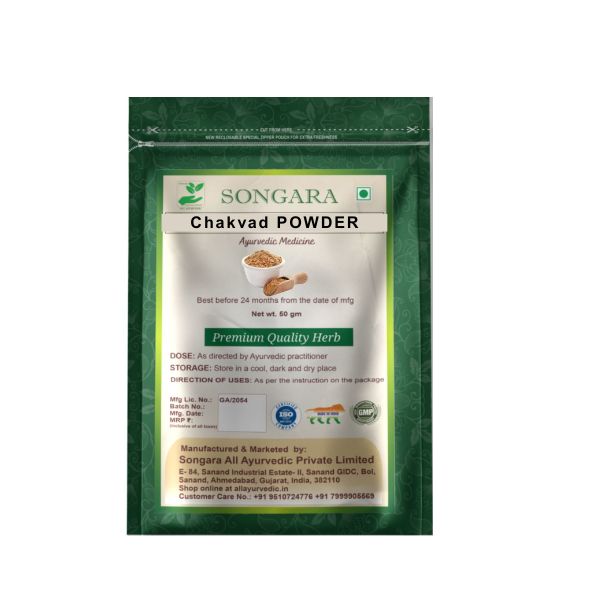
Chakvad Powder (Cassia Obtusifolia) – The Ayurvedic Detox Herb
Chakvad Powder (Cassia Obtusifolia) – The Ayurvedic Detox Herb
Couldn't load pickup availability
🌿 Chakvad (Cassia tora Linn.)
Family: Fabaceae (Leguminosae)
Sanskrit Name: चक्रमर्द (Cakramarda)
English Name: Fetid Cassia / Sickle Senna
🔹 1. Synonyms (पर्याय नाम)
- चक्रमर्द (Cakramarda): ‘चक्राणि दद्रुमण्डलानि मृद्नाति इति’ – It destroys circular skin patches like Dadru (ringworm).
- प्रपुन्नाट (Prapunnata): Reduces virility slightly (pumstva nādayati).
- दद्रुघ्न (Dadrughna): Destroys Dadru (ringworm).
- मेषलोचन (Mesalocana): Flowers resemble sheep’s eyes.
- पद्माट (Padmata): Flowers bloom at sunrise like lotus.
- एडगज (Edagaja): Emits sound or fragrance like an elephant (gaja).
- चक्री (Cakri): Grows gregariously in circular clusters.
- पुन्नाट (Punnata): Another name for Prapunnata.
🔹 2. Regional Names
| Language | Name |
|---|---|
| Hindi | Chakvad, Pavand, Pavara |
| Bengali | Chakunda, Panewara |
| Marathi | Tarota, Takala |
| Gujarati | Kumvadio |
| Kannada | Tagase |
| Telugu | Tagirisa |
| Tamil | Usidigarai |
| Punjabi | Pamvara, Chakunda |
| English | Fetid Cassia, Sickle Senna |
🔹 3. Botanical Description
Botanical Name: Cassia tora Linn.
Synonym species: Cassia obtusifolia Linn. (also considered Chakramarda)
- Habitat: Found throughout India, abundant in tropical regions.
- Type: Gregarious annual undershrub, 30–90 cm tall.
- Leaves: Pinnate, 7.5–10 cm long, with a conical gland between the two lowest pairs of leaflets; 3 pairs of opposite, obovate-oblong leaflets.
- Flowers: Pale yellow, in pairs at leaf axils.
- Fruits: Pods 12.5–20 cm long, containing 25–50 rhombohedral seeds.
- Odour: Slightly fetid.
🔹 4. Chemical Constituents
Major phytoconstituents:
- Anthraquinones: Chrysophanic acid, Emodin, Rhein, Aloe-emodin, Toralactone
- Flavonoids: Kaempferol glucoside, Leucopelargonidin-3-O-α-L-rhamnopyranoside
- Sterols: β-Sitosterol
- Other Compounds: Myricyl alcohol, Fatty acids, Amino acids, Chrysophanic acid-9-anthrone, Rubrafusarin, Phycion, Naphtho-a-pyrone derivatives
Pharmacological Activities (from extracts):
- Antibacterial: Effective against E. coli, Salmonella typhi, Bacillus megaterium, Corynebacterium diphtheriae.
- Antifungal: Active against Trichophyton rubrum, T. mentagrophytes, Microsporum canis.
- Antiviral: Exhibits interferon-like activity against Ranikhet disease virus.
- Oxytocic & Antimicrobial: Methanolic seed extracts show uterine stimulant and antimicrobial effects.
🔹 5. Properties & Therapeutic Uses (गुण और औषधीय उपयोग)
Rasa (Taste): Madhura (sweet), Tikta (bitter), Katu (pungent)
Guna (Qualities): Laghu (light), Ruksha (dry)
Virya (Potency): Ushna (hot)
Vipaka (Post-digestive effect): Katu
Doshaghnata: Pacifies Kapha and Vata
Therapeutic Actions:
- Kusthaghna (Anti-dermatitic): Cures skin diseases like Dadru, Kandu, Kushtha.
- Krimighna (Anthelmintic): Destroys intestinal worms.
- Kaphahara: Alleviates Kapha-related disorders.
- Vranaropaka: Heals ulcers and wounds.
- Hridya: Beneficial for heart.
- Vishaghna: Useful in poisoning.
- Kandughna: Relieves itching.
- Kasahara: Relieves cough and dyspnea.
- Gulmahara: Reduces abdominal lumps and swellings.
Traditional Applications:
- For Skin Diseases:
- Paste of leaves with Karanja taila or lime juice is applied on eczema, scabies, and ringworm.
- Seeds soaked in Snuhi dugdha and cow urine used on keloids.
- Paste with buttermilk used in Sidhma (tinea versicolor).
- For Digestive Disorders: Leaves decoction used for diarrhoea in children.
- As Food: Tender leaves used as pot-herb by tribal communities (Santals).
- Other Uses: Roasted seeds are used as a coffee substitute.
- Topical Relief: Leaf juice reduces burning due to Bhilawa (marking nut) contact.
🔹 6. Dose (मात्रा)
Powder (Churna)
1–2 grams
With warm water or honey
⚕️ Summary
Chakvad (Cassia tora) is a potent Ayurvedic herb with strong antifungal, antibacterial, and antipruritic properties. Traditionally used to treat Dadru (ringworm), Kushtha (skin diseases), and Kandu (itching), it also serves as a mild purgative and blood purifier. Its bioactive compounds like chrysophanic acid and emodin make it effective against dermatophytes and microbial infections.
Key Benefit: Natural skin purifier and anti-fungal herb supporting healthy skin and digestion
Ref: Bhavaprakash Nighantu
Materials
Materials
Shipping & Returns
Shipping & Returns
Dimensions
Dimensions
Care Instructions
Care Instructions
Share