Songara All Ayurvedic
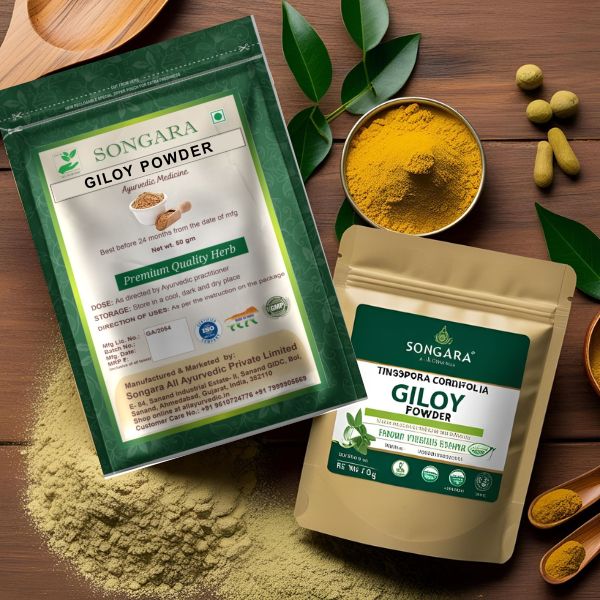
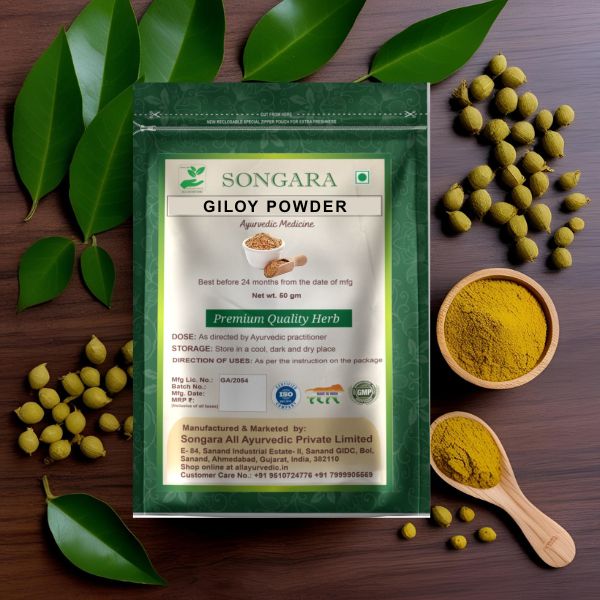
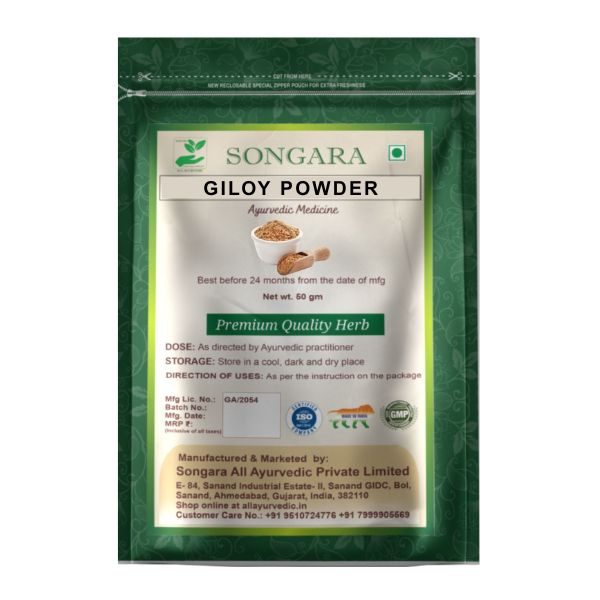
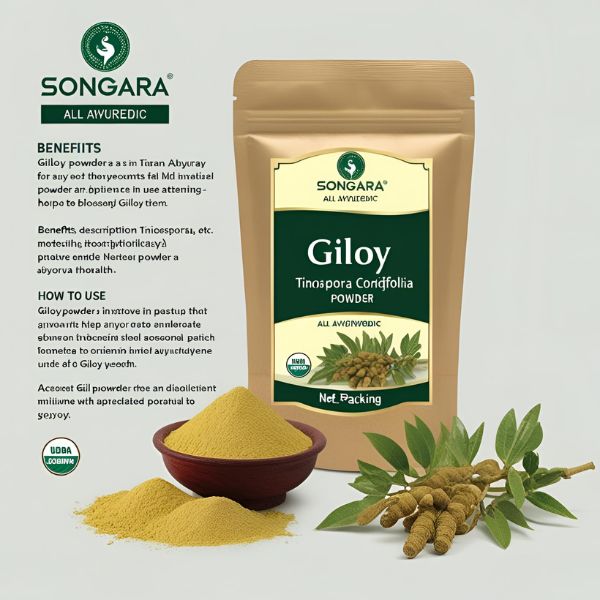
Giloy Powder – The Ultimate Ayurvedic Immunity Booster (50 gm)
Giloy Powder – The Ultimate Ayurvedic Immunity Booster (50 gm)
Couldn't load pickup availability
गुडूची (Gudūcī)
Botanical name: Tinospora cordifolia (Willd.) Hook. f. & Thoms.
Family: Menispermaceae
English name: Heart-leaved Moonseed / Tinospora
1. Synonyms (नाम पर्यायाः)
गुडूची, मधुपर्णी, अमृता, अमृतवल्ली, छिन्ना, छिन्नरुहा, छिन्नोद्भवा, वत्सादनी, जीवन्ती, तन्त्रिका, सोमा, सोमवल्ली, कुण्डली, चक्रलक्षणिका, धीरा, विशल्या, रसायनी, चन्द्रहासा, वयस्था, मण्डली, देवनिर्मिता इत्यादयः।
Etymological significance:
- गुडूची — “गुडति रक्षति इति” – one that protects or shields the body from diseases.
- मधुपर्णी — although its leaves are bitter in taste, they act beneficially on the body.
- अमृता / अमृतवल्ली — it never dies; compared with nectar (amṛta) for its life-promoting and rejuvenating power.
- छिन्नरुहा / छिन्नोद्भवा — regenerates even if cut repeatedly, symbolizing vitality.
- वत्सादनी — liked and eaten by calves.
- जीवन्ती — giver of life, sustaining vitality.
- तन्त्रिका — possessing fine thread-like aerial roots symbolizing life-energy flow.
- सोमा / सोमवल्ली — associated with divinity and vitality, the sacred “Soma” vine.
- कुण्डली / मण्डली — twining nature of the vine.
- चक्रलक्षणिका — marked with wheel-like structures on transverse section of stem.
- विशल्या — removes disease and doṣa (considered as foreign matter).
- रसायनी — possessing rejuvenative and immune-enhancing properties.
- चन्द्रहासा — having beautiful moon-like leaf appearance.
- वयस्था — prevents aging, maintains youth.
- देवनिर्मिता — said to be created by Lord Indra according to legend.
2. Regional Names (प्रादेशिक नामानि)
Hindi: Gurach, Giloe, Gulanch, Gulbel
Bengali: Gulancha
Marathi: Gulvel, Gulaveli
Gujarati: Galo, Gulvel
Tamil: Amritavalli, Sindilakodi
Telugu: Tippatige, Guduchi
Kannada: Amritaballi
Malayalam: Amrithavalli
Oriya: Guluchi
English: Tinospora / Heart-leaved Moonseed
3. Botanical Description (वनस्पति-वर्णनम्)
Tinospora cordifolia is a large, glabrous, perennial, deciduous, climbing shrub found throughout India, especially in tropical regions and moist deciduous forests.
- Stem: Thick, succulent, and covered with grey or creamy white bark, bearing warty lenticels; develops long filiform aerial roots from the branches.
- Leaves: Simple, alternate, broadly cordate (heart-shaped), 5–10 cm in diameter, glabrous and bright green.
- Flowers: Small, greenish-yellow, unisexual, borne on separate plants.
- Fruits: Red, drupe-like, ovoid, and single-seeded.
- Flowering and Fruiting: December to June.
- Habitat: Grows on trees such as Neem (Azadirachta indica), enhancing its potency (Neem-guduchi).
The root, stem, and especially the starch extracted from the stem (Guduchi-sattva) are used medicinally. It is best used fresh.
4. Chemical Constituents (रासायनिक संघटनानि)
The plant contains:
- Alkaloids: Tinosporin, Berberine
- Bitter principles: Columbin, Chasmanthin, Palmarin, Tinosporic acid, Tinosporol, Giloin
- Glycosides: Tinosporon, Tinosporoside
- Diterpenoid lactones: Furanolactone derivatives, 18-norclerodane diterpene-O-glucoside
- Other compounds: β-sitosterol, Octacosanol, Nonacosan-15-one, Aryltetrahydrofuran lignan
Pharmacological activities:
Antipyretic, anti-inflammatory, antispasmodic, hepatoprotective, hypoglycaemic, immunomodulatory, antimalarial, and antioxidant.
Guduchi extract enhances phagocytic activity, reduces blood glucose, regulates hepatic function, and stimulates immune response.
5. Properties and Therapeutic Uses (गुणाः तथा औषध-प्रयोगाः)
Rasa (Taste): Tikta (Bitter), Kaṭu (Pungent)
Guna (Quality): Laghu (Light), Snigdha (Unctuous)
Virya (Potency): Uṣṇa (Hot)
Vipāka (Post-digestive effect): Mādhura (Sweet)
Prabhāva (Specific action): Rasāyana (Rejuvenative), Tridoṣa-hara (Pacifies all three doshas)
Guduchi is deepana-pācana (digestive and carminative), balya (strength-promoting), rasāyana (rejuvenative), tridoṣa-hara, āmapācaka, medhya (brain tonic), and raktaśodhaka (blood purifier).
It alleviates fever, gout, jaundice, anemia, urinary disorders, diabetes (prameha), chronic skin diseases, cough, asthma, heart disease, piles, and general debility.
Classical references:
- Caraka Saṃhitā – mentioned in Sirovirecana dravya and Vamanopaga mahākaṣāya.
- Suśruta Saṃhitā – included in Aragvadhādi, Patolādi, Kākolyādi, Gudūcyādi and Vallipañcamūla gaṇa.
- Aṣṭāṅga Saṃgraha – described as Tikta, Amṛta, Tridoṣaghni, Grahiṇī, Uṣṇa, Rasāyanī, Dīpanī, Jvaratṛṭdāha-kāmalāvāta-raktanuta.
- Therapeutic applications:
- Jvara (Fever): Guduchi decoction with Pippali and honey in chronic fevers; in malaria and intermittent fevers.
- Kāmala (Jaundice): Juice of fresh stem with honey or paste with buttermilk.
- Prameha (Diabetes): Decoction with Haridra and Amalaki or juice with honey.
- Vāta-rakta (Gout): Decoction with Gokṣura and Amalaki, or with castor oil.
- Kustha (Skin disorders): Used with Guggulu, Nimba, Haridra, and Khadira.
- Śvāsa–Kāsa (Respiratory disorders): Decoction acts as expectorant and tonic.
- Kṛmi and Viṣa (Worms and Poisons): Acts as anti-toxic; used in snake and insect bites.
- Agnimāndya (Indigestion): Enhances digestion and removes āma.
- Rasāyana (Rejuvenation): Strengthens body, improves complexion, and promotes longevity.
- Immunomodulator: Prevents hepatic fibrosis, enhances immunity, improves glucose tolerance and insulin activity, and protects liver against toxins.
6. Doses (मात्रा)
- Cūrṇa (Powder): 250–500 mg twice daily with water or honey.
Guduchi should preferably be used fresh, collected before the rainy season (May–June). The Neem-supported Guduchi (Nimbāruḍha Gudūcī) is considered the most potent and sattvika variety.
Summary:
Guduchi, the divine “Amṛtavalli,” is one of the most valued Rasāyana drugs in Ayurveda. It restores health, purifies the blood, strengthens the immune system, and rejuvenates body tissues. Its name, meaning “protector,” perfectly reflects its nature — a guardian of vitality, longevity, and equilibrium.
Ref: Bhavaprakash Nighantu
Materials
Materials
Shipping & Returns
Shipping & Returns
Dimensions
Dimensions
Care Instructions
Care Instructions
Share