1
/
of
5
Songara All Ayurvedic
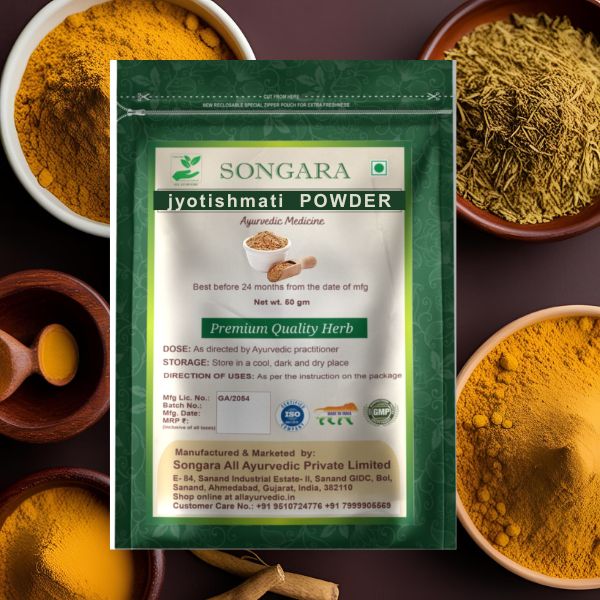
Jyotishmati or Malkangni Powder | Celastrus paniculatus - Pure & Natural Ayurvedic Herb
Jyotishmati or Malkangni Powder | Celastrus paniculatus - Pure & Natural Ayurvedic Herb
Regular price
Rs. 74.00
Regular price
Rs. 81.00
Sale price
Rs. 74.00
Taxes included.
Shipping calculated at checkout.
No reviews
Quantity
Couldn't load pickup availability
🌿 Jyotiṣmatī (ज्योतिष्मती)
Common Name: Mālkānganī / Intellect Tree / Climbing Staff Tree
Botanical Name: Celastrus paniculatus Willd.
Family: Celastraceae
1. Synonyms (पर्याय / समानार्थक नाम)
| Sanskrit Name | Meaning / Derivation |
|---|---|
| ज्योतिष्मती (Jyotiṣmatī) | “One possessing light or brilliance” – promotes intellect and memory; “ज्योतिः अस्ति अस्याः” (It has the brilliance of fire). |
| कटभी (Kaṭabhī) | “कटति आवृणोति” – a twining climber; fruits appear bright like fire. |
| ज्योतिष्का (Jyotiṣkā) | “Dyoṭamānā” – having shining yellow fruits. |
| कङ्गुनी (Kaṅgunī) | Seeds resemble millet grains. |
| पारावतपदी (Pārāvatapadī) | Branches resemble pigeon’s feet. |
| पण्या (Paṇyā) | Highly valued or traded herb; “Paṇyate” – worthy of commerce. |
| लता (Latā) | A climbing or twining plant. |
| ककुन्दनी (Kakundanī) | Grows in multiple directions, bushy habit. |
| लवणा (Lavaṇā) | Improves intellect (“लुनाति जाड्यं” – removes dullness). |
| सुवर्णलता (Suvarṇalatā) | Bearing yellowish flowers. |
| पीततैल (Pītataila) | Having yellow-colored seed oil. |
2. Regional Names (प्रादेशिक नाम)
| Language | Name |
|---|---|
| Hindi | मालकांगनी (Mālkānganī), मालकौनी (Mālkāunī) |
| Bengali | लता फटकी (Lata Phataki), बन उच्छे (Bana-Ucche) |
| Marathi | मालकांगोणी (Mālkāngonī), करडकांगोणी (Karadkāngonī), पिंगवी (Pingavī), पेंगी (Pengī) |
| Kannada | करिगन्ने (Kariganne) |
| Telugu | मालकांगुनी विट्टुलु (Mālakānguni Vittulu), बावंजी (Bāvanjī) |
| Tamil | वेलिलवेल (Vailulvai) |
| Malayalam | पलुलवम (Palulavam) |
| Gujarati | मालकांगना (Mālakānganā) |
| Oriya | पिंगा (Piṅgā) |
| English | Climbing Staff Tree, Intellect Tree, Oleum Nigrum Plant |
3. Botanical Description (वनस्पतिक विवरण)
- Botanical Name: Celastrus paniculatus Willd.
- Family: Celastraceae
- Habit: Woody climber (scandant shrub) with long, drooping branches.
- Leaves: Simple, alternate, glabrous; broadly ovate or obovate; acuminate apex.
- Flowers: Small, yellowish-green, arranged in panicles.
- Fruits: Globose capsules, yellow when ripe, containing 3–6 seeds.
- Seeds: Enclosed in bright red aril; yield yellow to deep scarlet oil.
- Habitat: Found throughout India—Outer Himalayas (Jhelum to Assam), Bihar, Bengal, and South India.
- Part Used: Seeds (primary), oil, leaves, root bark.
4. Chemical Constituents (रासायनिक संघटक)
Major Compounds Identified:
- Fatty Acids: Acetic, Benzoic, Formic, Linoleic, Linolenic, Palmitic, Stearic acids.
- Alkaloids: Celapagine, Celapanigine, Celapanine.
- Triterpenes & Esters: Celastrol, Celastrine, Paniculatine, Malkanguniol, Malkangunin (sesquiterpene ester), Paniculatadiol.
- Sterols: β-Sitosterol, β-Amyrin, 5-Stigmasten-3β-ol.
- Other Constituents: Pristimerin, Zeylasterol, Zeylasterone, n-Triacontanol (from root bark).
Oil Content:
- Seeds yield ~52% dark brown oil (Celastrus oil / Mālkānganī oil).
- Oil is rich in sesquiterpenes and polyalcohols with potent neurostimulant properties.
5. Properties and Therapeutic Uses (गुण एवं औषधीय उपयोग)
Ayurvedic Properties (आयुर्वेदिक दृष्टि से):
- Rasa (Taste): Katu (Pungent), Tikta (Bitter)
- Guna (Quality): Laghu (Light), Tikshna (Sharp)
- Virya (Potency): Ushna (Hot)
- Vipaka (Post-digestive effect): Katu (Pungent)
- Doshic Action: Pacifies Kapha and Vāta doshas
Classical References:
- Caraka Samhitā: Listed in Śirovirecana Dravyas (brain-purifying group).
- Suśruta Samhitā: Mentioned in Adhobhagahara and Śirovirecana gana.
Pharmacological Actions (औषध क्रियाएँ):
- Medhya (Brain Tonic): Enhances intellect, memory, and cognitive clarity.
- Vahnivardhaka: Stimulates digestive fire and metabolism.
- Nervine Stimulant & Tonic: Rejuvenates brain cells and nerves.
- Diaphoretic: Promotes perspiration and detoxification.
- Emetic & Purgative: Clears toxins from the body.
- Antidepressant & Tranquilizer: Helps reduce anxiety, stress, and depression.
- Anti-inflammatory & Antipyretic: Reduces inflammation and fever.
- Aphrodisiac: Promotes sexual vitality and vigor.
Therapeutic Uses (चिकित्सीय उपयोग):
| Condition / Disease | Therapeutic Use |
|---|---|
| Cognitive Decline, Memory Loss | Improves memory, concentration, and learning ability. |
| Depression, Hysteria | Acts as a natural antidepressant and nervine tonic. |
| Neurological Disorders | Useful in paralysis, neuralgia, and epilepsy. |
| Arthritis & Rheumatism | Oil used for external massage for pain relief. |
| Skin Diseases | Detoxifies blood and heals non-healing ulcers (seed paste). |
| Digestive Issues | Stimulates digestion and relieves gas and constipation. |
| Ascites & Beri-Beri | Used as diuretic and stimulant. |
| Hair & Brain Tonic | Applied on scalp with ghee to enhance memory and hair health. |
6. Dosage (मात्रा / उपयोग विधि)
| Form | Recommended Dose | Usage |
|---|---|---|
| Expressed Oil (Malkangni Taila) | 2–10 drops daily (internal) | Mixed with milk or honey, or applied on scalp with ghee for brain nourishment. |
| Black Oil (Oleum Nigrum) | 5–15 drops as diaphoretic; up to 30 drops as diuretic | Taken with warm water or milk. |
| Powdered Seeds (Churna) | 1–2 g initially, gradually increasing up to 50 seeds/day (under medical supervision) | Taken with Sunthi (dry ginger powder) and warm milk. |
| External Application | Seed oil with butter or sesame oil | Massage for rheumatic pain, paralysis, and hair nourishment. |
7. Modern Research Highlights (आधुनिक अनुसंधान)
- Cognitive Enhancement: Improves learning and memory retention in animal studies.
- Tranquilizing Effect: Exhibits calming effects comparable to synthetic sedatives.
- Antidepressant: Significant improvement in mild to moderate depression.
- Anti-inflammatory & Antipyretic: Reduces inflammation and fever in laboratory models.
- Hepatoprotective: Alcoholic extract protects liver from drug-induced toxicity.
8. Safety, Storage & Precautions (सुरक्षा एवं सावधानियाँ)
- Storage: Store in cool, dry place; protect from direct sunlight and heat.
-
Precautions:
- Avoid high doses due to potent stimulant properties.
- Use under medical supervision during pregnancy.
- Root bark known to be abortifacient—should not be used internally.
🌼 Summary
Jyotiṣmatī (Mālkānganī) is an ancient Medhya Rasāyana (intellect-promoting herb) revered in Ayurveda for enhancing memory, intelligence, and mental clarity. Its seed oil is a powerful nervine tonic, antidepressant, and stimulant, also used externally for arthritis, paralysis, and hair vitality. With proven modern research support, Jyotiṣmatī bridges traditional wisdom and contemporary neurotherapeutics.
Materials
Materials
Shipping & Returns
Shipping & Returns
Dimensions
Dimensions
Care Instructions
Care Instructions
Share
No reviews