1
/
of
5
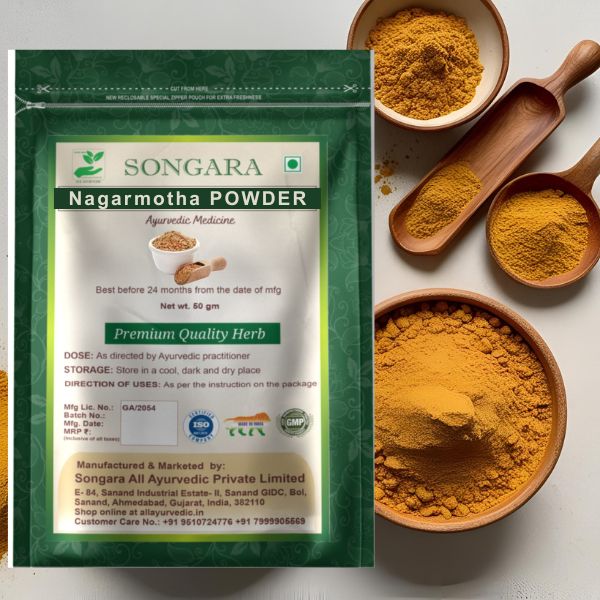
Songara All Ayurvedic
Nagarmotha Powder: Cyperus Scariosus
Nagarmotha Powder: Cyperus Scariosus
Regular price
Rs. 35.00
Regular price
Rs. 35.00
Sale price
Rs. 35.00
Taxes included.
Shipping calculated at checkout.
No reviews
Quantity
Couldn't load pickup availability
🌿 Nagarmotha (Nāgaramustaka / Mustakam)
Botanical Name: Cyperus rotundus Linn.
Family: Cyperaceae
Common English Name: Nutgrass, Purple Nutsedge
1. Synonyms (पर्याय / समानार्थक नाम)
-
Sanskrit Synonyms:
मुस्तक (Mustaka), मुस्त (Musta), वारिद (Vārida), कुरुविन्द (Kuruvinda), क्रोडकसेरुक (Krodakaseruka), भद्रमुस्ता (Bhadramusta), गुन्द्रा (Gundrā), नागरमुस्तक (Nāgaramustaka) - Etymological Meanings:
- मुस्ता: “मुस्यति खण्डयति रोगान्” – That which destroys diseases.
- वारिद: “वारि ददाति” – Brings moisture, like a cloud.
- कुरुविन्द: Found in Kuru-desha (Northern India).
- क्रोडकसेरुक: Liked by pigs (Varāha-priya).
- गुन्द्रा: Grows near water reservoirs.
- नागरमुस्तक: Found near human settlements.
- भद्रमुस्ता: Promotes good health (Bhadrata).
2. Regional Names (प्रादेशिक नाम)
| Language | Name |
|---|---|
| Hindi | नागरमोथा (Nagarmotha) |
| Bengali | नागरमुथा (Nagaramutha) |
| Marathi | नागरमोथा (Nagarmotha), लवाळा (Lavalā) |
| Tamil | कोर किझंग (Kora Kizhanga) |
| Malayalam | कोर किझंग (Kora Kizhanga) |
| Telugu | तुंगगडलेवरु (Tungagadda Laveru), कोलतुंग मुस्ते (Kolatunga Muste) |
| English | Nutgrass, Purple Nutsedge |
3. Botanical Description (वनस्पतिक विवरण)
- Botanical Name: Cyperus rotundus Linn.
- Family: Cyperaceae
- Habitat: Commonly found in marshy and damp regions such as Bengal, Uttar Pradesh, and other parts of India.
- Plant Type: Slender, perennial, grass-like herb.
- Height: 16–36 inches.
- Stem: Triangular (trigonal).
- Rhizomes: Slender, aromatic, finger-like, brownish black tubers underground.
- Leaves: Narrow, grass-like, arising from the base.
- Flowers: Small, reddish-brown spikelets arranged in umbels.
4. Chemical Constituents (रासायनिक संघटक)
-
Major Active Compounds:
- Sesquiterpenes: Cyperene I & II, Cyperotundone, Cyperol, Cyperolone, α-Cyperone, β-Rotunol, α & β-Selinene, (+)-Rotundone, Mustakone, Kobusone, Isokobusone, Epoxyguaiene, Patchoulene, Humulene.
- Fatty Acids: Linoleic acid, Linolenic acid, Myristic acid, Oleic acid, Stearic acid.
- Sterols & Flavonoids: β-Sitosterol, Rhamnetin-3-O-rhamnosyl-rhamnopyranoside, Oleanolic acid-3-O-neohesperidoside.
-
Pharmacological Activities:
- Anti-inflammatory
- Anti-malarial
- Hepatoprotective
- Lipolytic (fat-reducing)
- Antimicrobial
- Antioxidant
5. Properties & Therapeutic Uses (गुण तथा औषधीय उपयोग)
Ayurvedic Properties (आयुर्वेदिक दृष्टि से):
- Rasa (Taste): Tikta (Bitter), Katu (Pungent), Kashaya (Astringent)
- Guna (Quality): Laghu (Light), Ruksha (Dry)
- Virya (Potency): Shita (Cold)
- Vipaka (Post-digestive effect): Katu (Pungent)
- Doshic Action: Pacifies Kapha, Pitta, and Rakta doshas
General Actions:
- Dipana (Appetizer)
- Pachana (Digestive)
- Lekhana (Scraping)
- Stanyashodhaka (Purifies breast milk)
- Krumighna (Anti-worm)
- Jwaraghna (Antipyretic)
- Trishnaghna (Relieves excessive thirst)
- Raktaprasadana (Purifies blood)
Therapeutic Uses (उपयोग):
- Digestive Disorders: Useful in diarrhea, dysentery, indigestion, and loss of appetite.
- Liver & Spleen: Acts as a liver protective herb; helps in jaundice and hepatomegaly.
- Fever: Effective in intermittent and malarial fevers.
- Skin Diseases: Detoxifies blood and alleviates skin irritations and itching.
- Obesity: Reduces excess fat due to its lipolytic action.
- Women's Health: Useful as a galactagogue (stimulates lactation) and purifies breast milk.
- Hair Care: Rhizomes are a common ingredient in hair oils for promoting growth and reducing dandruff.
- Wound Healing: Paste of rhizomes with ghee heals wounds and ulcers.
- Thirst & Alcoholism: Decoction relieves excessive thirst caused by heat or intoxication.
Classical References:
- Caraka Samhita: Mentioned in Lekhaniya, Kandu-ghna, Stanyashodhana mahakashayas.
- Sushruta Samhita: Listed in Vacadi and Mustadi ganas.
6. Dosage (प्रमाण / मात्रा)
| Form | Adult Dose |
|---|---|
| Churna (Powder) | 3–6 g with honey or water |
| Kwatha (Decoction) | 50–100 ml twice a day |
| Taila (Oil) | External application for hair or massage |
| Swarasa (Juice) | 10–20 ml once or twice daily |
7. Modern Research Highlights
- Anti-inflammatory: β-Sitosterol from tubers shows effect comparable to hydrocortisone.
- Anti-malarial: α-Cyperone and related sesquiterpenes active against Plasmodium falciparum.
- Hepatoprotective: Alcoholic extract protects liver against CCl₄-induced damage.
- Anti-obesity: Lipolytic effect by increasing biogenic amines that suppress appetite.
8. Safety and Storage
- Storage: Keep in cool, dry place away from moisture; tubers prone to fungal infection (Aspergillus, Curvularia, Alternaria).
- Safety: Non-toxic in traditional doses; avoid during pregnancy without medical supervision.
🌱 Summary
Nagarmotha (Cyperus rotundus) is an ancient Ayurvedic herb valued for its digestive, detoxifying, and anti-inflammatory properties. From reducing obesity and improving liver function to enhancing hair growth and balancing doshas, it remains one of Ayurveda’s most versatile herbs.
Materials
Materials
Shipping & Returns
Shipping & Returns
Dimensions
Dimensions
Care Instructions
Care Instructions
Share
No reviews